Why I hate my crazy neighbor (or The Fencing Project from Hell)

I love my crazy neighbor because he is an enabler.  He has enabled me to buy new fences and nice new horse shelters.  He enabled me to begin building a turnout area—I mean buffer zone—protecting the horses from his stallions.  He even enabled us to buy a tractor!  What a guy!  And now (by the laws of deductive logic), he is enabling us to buy all sorts of implements for our tractor.  Those of you out there who own tractors know what I am talking about.

A typical trip to the feed store:
Me:  What is that implement thing out there on display?
Feed store guy:  It’s a Lurminator.
Me:  I need one.  What does it do?
Feed store guy:  It Lurminates.
Me:  How much does it cost?
Feed Store Guy:  $700
Me:  Here is my credit card.

After this, I go on my merry way, secure in the knowledge that A.  If I ever need to Lurminate, I will possess the correct implement and B.  Any tractor implement under $1000 is worth having.

We bought this blade.  But it couldn’t be just any blade.  David did his research and it had to be a Swiss Army Blade that will not only fold, spindle and mutilate, but has those teeny-beeny tweezers in a pocket so that you can pull out any annoying little splinters.  And we bought an auger, which it turns out consists of several parts (sold separately) such as the “arm thing” and the “spinny things,” which come in several different sizes—small, medium, tall, venti, and ridiculous.  Buying an “arm thing” without at least two “spinny things” is kind of like buying Malibu Barbie without also buying the Malibu Convertible, Malibu Ken, Malibu Beach Mansion and optional Malibu Sunglasses (for both Barbie and Ken, naturally).

So we drove home triumphantly from the Tractor Supply Company store with our latest kill and, somehow, David managed to assemble the whole shebang.  (Little known fact:  Albert Einstein died of old age while trying to assemble the “arm thing” for his tractor.)  And we drove the tractor to a place on our property that I had scientifically determined would be the absolutely correct place to put a fence post and we drilled our first hole!  And it was one foot deep… Because after the auger went down about a foot, it hit a layer of soil that geologists refer to as “concrete,” and then it just sat there spinning happily away, but not actually doing anything useful in terms of what geologist refer to as “digging a hole.”  And now you know why I hate my crazy neighbor.  I am quite certain that he is down there living in his disgusting, filthy trailer with his stallions running around loose because he has crappy falling down fences, looking through his expensive high powered telescope at us struggling to dig post holes—and LAUGHING AT US!  I’ll bet he lets his stallions out every few weeks just so he can come up and laugh at our feeble efforts at erecting a fence to keep them out.

At first, we worked really hard at this project.  We would dig any time we had a spare day.  We began by drilling the 12” holes for the big posts that would be our corners and gate supports.  These holes needed to be 4 feet deep, so you can see that a 1 foot hole just wasn’t going to cut it.  We discovered that by pouring water down the 1 foot hole, we could soften up the soil and a few days later, we could drill it all the way down to 15 or even 18 inches deep—progress!  We also discovered that through the use of backbreaking labor with a “rock bar” we could loosen up the soil for the auger and make another inch or two of progress.  And occasionally, we were lucky enough to actually dig an entire hole at which point, we would put a post in it and celebrate.  Our property began to look like we were sprouting a random crop of railroad tie trees.  We also had to purchase an “extension thing” for the auger because, at first, it would not dig a 4 foot hole—silly auger.  (I guess you could call that auger augmentation.)

And we discovered the existence of “shear pins.”   A shear pin is an evil piece of equipment that is designed to protect your auger from being bent (HA! We’ve proved that one wrong) by breaking anytime it thinks the auger might get damaged by hitting a rock or a tree root, or if it’s a little stressed that day, or if it had one too many cups of coffee or has PMS, or somebody sneezes or a rabbit runs in front of the tractor.  We discovered that it is not humanly possible to possess enough shear pins to get through an entire post hole digging operation, because due to Newton’s fourth law of Shear Pins, you will always have one fewer shear pin than you need to finish the hole!  We now measure our hole digging efforts in terms of SPU’s or Shear Pin Units.

“That was an easy hole—it only broke four shear pins!”

And then we stalled out…

And when I say we stalled out, I’m talking about “for several years” stalled out, not just for a couple of weeks or months.  We were killing ourselves physically, not to mention wiping out the shear pin population of Northern Nevada, and we still had some holes that we had made ABSOLUTELY NO progress on.  There were these divots on the ground where holes were supposed to go and that was as far as we could get.  There was one corner post where we had hit a rock about 3 feet down and we absolutely couldn’t get around it without dynamite or some sort of tactical nuclear weapon.  Oh, we had tried a few different “tricks” that our “friends” had told us about.  (Like pouring very diluted battery acid down the hole to dissolve the clay?  Ignoring our fears about poisoning the environment on the theory that it would be worth it to create 6 legged horned toads if we finally had a fence, we tried this—it didn’t do diddly squat.)  We think now that our friends were down at Tom’s using his telescope and laughing along with him.

And then Providence showed us the way…  Our neighbors down the hill decided to put in a fenced yard for their dogs.  They didn’t actually do it themselves—they had some fencing guys do it for them.  I watched this project unfold over several days driving to and from work and finally had to stop and ask—“HOW THE HELL DID THEY DIG THOSE POST HOLES!”  I probably said it a little more nicely than that, but that was the gist of it.  It turned out that they had used a Bobcat.  The difference between the Bobcat and our tractor is that the Bobcat possesses a mysterious, magical force known as downpressure.  This would be like having a second tractor jump up and down on top of the auger while the first tractor was digging the hole—BRILLIANT!

So we rented a Bobcat—actually a “Skid Steer” (because it is made by Case and not Bobcat).  Whatever it was, it was pretty reasonable to rent—only about $100.  Of course, it cost $200 to have it delivered and picked up, and each of the two augers cost about $100 to rent, but it was still worth it.  The Skid Steer had downpressure and it didn’t have any shear pins on the theory that if you got it stuck enough to bend one of these augers, you would create enough force to spin the planet Earth off of it’s axis causing global devastation anyway.  And we dug 52 holes in two days!  I sure hope Tom happened to notice that we were out digging and thinking to have himself a knee slapping afternoon, glanced through his telescope at which point his eyeball must have shot cartoon like out the other end of the telescope in amazement—take THAT!

We don’t, at this point, have any actual fences yet.  All of the wooden posts are in, though.  They march along in straight lines instead of random patterns, beckoning to me.  Now all we have to do is install all of the H’s, drive about a gazillion T-posts and string fence.  And now I can truly say “Thank you Tom, for enabling us to go out and buy a T-post driver implement for our tractor!”
Why I love my crazy neighbor

Some of you know I have a crazy neighbor.  And when I say I have a crazy neighbor, I mean that literally.  And when I say literally, I mean that in the literal sense of the word literally, not the metaphorical (or hyperbolic) sense as in “like literally” which translates into:  I think I am really exaggerating when I say this, but I’m literally showing my ignorance because I don’t know what the word literally means.  But I digress.  Anyway, somewhere out there, there is a test—I believe they are referred to by the politically correct as “inventories” such as the ABC1 or OCD3, and if you administered this test to my neighbor “Tom” (we’ll call him, not that that’s his real name), he would qualify as having some actual (literal) mental disorder.  Using my vast knowledge of psychology (gained from one high school class and one college class) I have decided that he is schizophrenic or bipolar or maybe something else. Actually, just understanding that he is literally mentally ill has made the situation easier for me to deal with.   I now have a sense of humor about it—he’s not a jerk, he’s just nuts!  And I’m not angry with him anymore.  Even though sometimes I really want to scream at him “Take a bath! Get a haircut! Put on clean clothes! and Get a job!” I understand that he is not truly capable of these things, so I am free to deal with him on his level and not expect too much.

Anyway, apparently God talks to Tom and somewhere along the line God told Tom that he needed to own three horses.  This is according to my other crazy neighbors who have talked to him (and now I mean crazy in the metaphorical sense of “wacky” or “a little off” which are strict requirements on the entrance exam for those moving into our neighborhood).  According to the neighbors, Tom has two grown children hiding out there—I mean living somewhere else—and God told Tom that his children would return to him and they would all need horses to ride.  No one seems to know when this would happen or where God told him to ride the horses or if God told him to ride English or Western or use a bitless bridle or go shod or barefoot or anything interesting like that.  Whatever is supposed to happen hasn’t happened yet and we’ve been here going on ten years now.  So Tom started with one appaloosa mare and (I’m kind of speculating here) bred her to produce a colt?  Then either he bred her again or maybe she bred with her colt?  I don’t like to think about that one, but the end result was another colt.

The problem is that God left out one very important piece of information that belongs in this puzzle.  God forgot to tell Tom to geld these colts.  Tom actually  believes that God has told him it is a sin to geld a horse, which is sort of counterproductive to the situation.  So time passed… and they grew up… and now they are full-grown stallions… and I have a mare… and eventually they figured that out.  So one day, they showed up at our place to “visit” my mare.  They broke her out of her electric corral and fortunately, she was so freaked out about being chased around by two crazed stallions that when I opened the gate of a solid pipe corral, she shot in there as quick as she could to get away from then and I slammed the gate in their faces.  God also seems to have forgotten to tell Tom to teach them manners.  You (metaphorically) could not pay me enough money to stand within 10 feet of one of these horses.  I’m not afraid of them, but I’m not stupid either.   Neither is Tom  (stupid I mean)—he may be crazy, but he is smart enough to know that leaving his horses rampaging around our property might be a bad idea.  He came right away and got them.

Thus began a long cycle of stallion visits from one or the other or even both of the two stallions.  And thus began a series of corral upgrades on my side of things.  Can you see why I love my neighbor now?  Well, first, the horses had to have all pipe corrals—no more electric fence.   So we bought a bunch more pipe fencing.  And they needed better shelters, so we bought two more of those.  The shelters had to be well anchored to prevent them from blowing away which meant digging holes to pour concrete posts to attach the shelter to.  The holes were really hard to dig, and how were we ever going to move the dirt necessary to fill the foundations?  You guessed it—we had to buy a tractor.  Then the whole shootinmatch needed to be enclosed in a perimeter fence so that the stallions could rampage to their heart’s content “over there” and not near my horses.  So I drew up plans to fence off about 10 acres with our little horse area on the inside.  Then we moved our “bathroom shed” which has a composting toilet over to the horse area so I now have a little tack/storage shed, but also a bathroom.  I often feed in the dark in the winter, so David has installed “much needed” lighting.

I have not, yet, figured out how to justify a new saddle or a real hay barn or a new trailer out of this, but I’m working on it.

And for those of you who wonder why I don’t “do” something about the stallions, I don’t have a lot of options.  Fencing them out is the Nevada way of dealing with them.  I could probably shoot one of them and claim self defense and get away with it, but I don’t blame the horses for this situation.  It would be better if I tried to shoot one and missed and “accidentally” hit Tom, but I’m pretty sure I wouldn’t get away with that.  I have offered to pay to have the horses gelded, but Tom just said that God would think that was wrong.  I have even considered offering to buy the two horses and gelding them myself, but I’m pretty sure Tom wouldn’t sell them to me (he’s crazy, not stupid, remember?  He knows the first thing I’d do to them.).  One friend and I came up with a wild scheme to put a loudspeaker under Tom’s trailer and speak to him in the middle of the night:

“TOM! THIS IS GOD!  GELD THE HORSES!”

But hatching that scheme is one thing—carrying it out would make ME certifiable—and I mean that—like literally.

The Adventures of Tigger the Tractor

When people commented on Facebook that we should turn our lives into a sitcom, several tractor episodes sprang immediately to mind.  Tigger is our tractor.  Someday after I win the lottery, inherit a fortune and rob a bank, I will have her paint job redone in orange with black stripes and perhaps a cute Tigger face painted on her cowling.  Why Tigger?  All one needs to do is take a ride around the property to understand. She is bouncy, jouncy, pouncy, flouncy, fun, fun, fun, fun, fun…

Heck!  Just buying Tigger was a real adventure.  We knew we needed to buy a tractor, so David, my “more of a sitcom husband in real life than anything Hollywood writers could think of” husband did what he always does—he did research.  David’s nickname is “The Research King.”  I can’t tell you how many brochures we have collected over the years for things we will probably never buy because he wanted to know more just in case someday he ever does decide to buy one of those things and thank God we have a brochure for it (if we can actually find the brochure) because it might prevent us from buying the wrong thing and thereby avert almost certain disaster…  When I bought our truck, he called horse trailer dealers all over the west coast and asked them what kind of truck they thought we should buy based on their horse hauling experiences.  You can see why he is the perfect sitcom husband.  Fortunately for us, the Internet has eliminated the need for a larger house to hold all of our brochures.

And the hell of it is that he is right.  I can’t make as much fun of him as I’d like to because he often uncovers facts that help us make better decisions.  So he went on the Internet and decided that we should purchase a Kubota tractor because Kubota is the gold standard of tractors.  They hold their value well, they are widely available and unlike the tractors made in Korea or India or Poland (yes, there are even those), parts and service are widely available and the company (and/or country) doesn’t seem likely to go belly up anytime soon.  We also decided we need something around 45 horsepower to do the work we need done.  So one day, we drove around to tractor dealerships and looked at Kubota’s.  Mostly we looked at new 25 horsepower tractors, because these are what the dealers have in stock.  Seems everybody wants one of those “cute little tractors” not realizing that they can’t do a whole hill of beans unless you are lucky enough to live on, well, a hill of beans which are really easy to dig in.  Plus new 45’s cost a whole lot more.   Hmmm…  Maybe we should be looking for a used tractor?

This is when we discovered one of the absolute truths of tractor ownership.  A certain percentage of tractor buyers are perfectly happy with their 25 horse power tractors because they probably didn’t need to move much dirt anyway and just wanted it to prove to their neighbors that they are real heavy equipment stud muffins.  But the percentage like us—they know what they want—they have work to do—they want a bigger tractor!  So they move up.  The smart ones go sink a boatload of money into a used skip loader or backhoe that a construction company is selling off and are done for life.  Many, though, move up to a 45.  And then they discover?—they want a bigger tractor!  Unfortunately, although you might think the expression “boatload of money” is hyperbole, it is not.  Still, there are a lucky few who will have the wherewithal to move up again and they will sell off their used 45 horsepower tractors.  So there are used 45’s out there to be had, only there is a large segment of dissatisfied 25 horsepower owners out there waiting cat-like, to pounce as soon as they go on the market.  This doesn’t work well for David at all—he likes to think about things.  He likes to do his research.

We had five or six tractors sold out from under us before we could even go look at them.  Soon, we learned the correct language to use:

“Hi, I see you have a used 45 HP tractor for sale.  Here is my credit card number.  Please hold it for me—I’m on the way now.”

We actually found one in San Bernadino.  We were working out the logistics of having it trucked to us.  We faxed the credit application.  The nice lady on the phone said “Okay, everything is in order.  All I need to do now is go look up the serial number of the tractor…”

Um… yeah… she couldn’t find it.  It was filed off.  The tractor was stolen.

Turns out the tractor was stolen when it was brand new.  This was the fourth “owner.”  He had no idea.  But really, the tractor belonged to Kubota.  We wanted it anyway.  Would they sell it to us?  Sort of, but it would take some time to file all of the proper paperwork, blah, blah, blah.  Then… later that same day, another 45 HP tractor came up for sale in Klamath Falls.  We gave them our credit card number, borrowed a truck (too heavy for mine), borrowed a trailer and left for Klamath Falls about 4 the next morning.  By one o’clock, we were the proud owners of Tigger.  About an hour out of Klamath Falls, we stopped to let the dogs pee and David checked that the serial numbers matched—whew!  Not stolen.

Wow!  That’s a whole episode right there.  There will have to be another one where we discover that we “need” at least one of every implement made for a tractor (and how much they cost).  There is definitely an episode about the time we got the auger stuck in the clay and practically had to disassemble the tractor to get it out (and then actually bent the auger).  There has got to be one about all of the crazy things you can do with a tractor that you didn’t think you could do.  And I’m pretty sure there’s an episode entitled “things you should not do with your tractor.”  And if you know anybody who is selling a nice 70 to 100 Horsepower used Kubota, I have a credit card number just waiting for them.

TnT notes: If I blow in your ear, will you follow me anywhere?

Still on the first morning!  Our first activity was working with Trevor on a 12 foot line.  He asked the question “How do you lead your horse?”  Because how you lead your horse around on a regular basis is going to affect how well your liberty is going to go.  Is your horse really “with” you as you lead him? The challenge he gave us was to lead our horses on a loose line and encourage them to bring their withers nearer to our shoulder.  Basically, you would be leading from about zone 2 or 3 as you would if you were playing “stick to me.”  Those of you who were at the Jonathan Field presentation last year may remember he referred to this as the sweet spot. Next, Trevor challenged us to turn this into a circling game where your horse is still mentally with you.  To do this, you would ask the horse to continue to bend his body around you as he circles as opposed to pushing his ribs or shoulder into you in a brace.

Yeouch!  This is a real challenge for Dolly and me.  This is one of those intangible “things” I have been trying to figure out since I started Parelli.  How do you get your horse to bend around you on a small circle at liberty?  I see videos of people circling their horses at the trot and canter at liberty.  The horse is on less than a 20 foot diameter circle and his body is bent around the person in a sort of moving bear hug.  I got Po to do it, but the darned thing is:  I Don’t Know How!  I’m beginning to think it is not really a behavior as such at all, but an outward manifestation of the quality of the relationship.  You can’t really teach the horse to do it.  You just keep plugging away at the ingredients long enough and building the relationship of trust as you go until one day, the horse just wants to do it.   (At least that is how it was with Po–one day, he just somehow “got it” and that was that.)  So what Trevor had us doing was working on the ingredients, but the actual “hug” may not come for a while.

Dolly and I were quite successful at walking with her in the “sweet spot,” because we have been leading this way ever since seeing Jonathan Field talk about it last year.  We are also good at bending her around me while leading because this is something I have been doing since I first audited a Karen Rolfe clinic.  But when we try to turn this into a circle it all falls apart.  Dolly immediately goes “bad banana” on me.  I can almost feel her pushing that inside shoulder against me as if to shove me aside even though she is at the far end of the lead.   This is how she will do it at liberty also—if I can even get her to stay on a small circle.  It is more like a weird sort of triangle.  We start with the send… I get about a quarter to a third of a circle-ish segment, then she drifts out…I partially disengage and she says:

“Fine, you want me close, I’ll give you close!”  And here comes the shoulder.

I say, “please get that shoulder out of here.”

She says, “fine, you don’t want me close.  I’m leaving!”

Partial disengagement, lather, rinse, repeat…

I have had limited success using a neck rope for this.  The idea is “look, I have nothing on your head, but you still need to stay on this small circle!”  Dolly is not convinced.  But since Dolly and I have just reached a new level of trust and understanding this year, I am willing to be patient.  This, too, will happen.  Right now, we will work on ingredients.

As we played (struggled really) with the circle at the clinic, I heard Trevor talking to another participant about asking the horse to move the ribs away to help achieve the proper bend.  I have been doing this previously, but decided maybe I should be doing more.  I got more assertive about asking her to move the ribs away and she leaped into the air.  But she did achieve the proper bend for a few strides.  Hmmm…  Later Trevor made a comment about how I have a lot of energy in my body (really?).  In the next segment, Tara made the same comment, which really made me think.   Hmmm….  Either they are telepathic, or maybe… maybe I have a lot of energy in my body.   And is this perhaps contributing to the brace?  It kind of feels like somebody handed me a diving belt right now.  If you’re a scuba diver, you need a heavy belt to counteract your buoyancy and hold you underwater long enough to see interesting or important things.  Without the belt, you would just keep popping out of the water before getting a good look around.   (Kind of how I feel at clinics sometimes.)  So now I have this belt and I’m wandering around in the murky depths trying to see something interesting or important—I know there is something really profound out there, but I am still groping around and trying to make sense out of it.  How is my energy causing the brace and what do I have to change to make the whole picture change?

I’ll tell you if I ever get there.  I have played with the circles a few times since the clinic, but still without much change.  I try toning my energy down and Dolly moves like she is swimming through molasses—if at all.  (And she still braces the shoulder).  I know I am expecting too much of myself right now.  We have gone from being absolutely unable to do liberty because she would just panic and run and run until I simply had to walk away, to having some nice things happen and having some good trust and communication between us.  So my mantra now is “ingredients, ingredients, ingredients.”

The final “death” toll

Those of you who have been following my lightening hit story might be interested to hear about this.  So far the count is:

One inverter—all three circuit boards fried

One back-up generator—control board fried.  It has been kind of scary living without back-up power.  The weather keeps telling us clear skies but apparently they forgot to add the sentence “but maybe with some clouds in them,” because we have had several cloudy days in there.  We finally got full power to the batteries on Tuesday so I immediately did the laundry.  David should be able to fix this soon–he finally got the new board today.

Two motion sensor security lights on garage.  These may actually be okay, but the wiring that leads to them is fried.  We won’t know until David rewires that area of the garage.

One florescent light fixture in garage—same scenario as the security lights…

One communications hub that allowed the inverter, charge controllers and mate to talk—fried circuit boards

The oven—inexplicably as it is nowhere near the garage—control board fried.  This fix is not too expensive, but of course, now we are looking at new and better ovens!  I had to do something for a fellow staff member’s birthday this week, so I bought a bunch of cake and frosting mix on sale figuring I would make cupcakes for all the kids.  As I was driving home, I got to do the classic head slap doubletake–no oven!  Duh…  So I made a special trip to CostCo Sunday to buy a cake, and I still have enough cake mix to make cupcakes for the whole school if the oven ever gets fixed.  Now all I need is a reason…

One solar panel (Thank God only one)—not sure if this was an arc from the main bolt that shattered the glass or the surge coming up the wires from the garage.  Anyway, replacing one solar panel turns out to be nearly impossible because you can never find one that matches, so this one has us almost completely stumped.  David and his friend, Greg, are thinking of trying to repair the panel just to see if they can, but ultimately we may end up having to replace the entire array.

The mate maybe?  Still not sure about that…  (The mate is a little device that lets you talk to the charge controllers, inverter, generator, Skipper, movie star, professor and Marianne, millionaire and his wife.)

A few shingles on the garage roof

The dryer still works, but it doesn’t shut off anymore.  It finishes its cycle, buzzes to tell you it’s done, then continues to spin and blow cold air until you stop it or (presumably) lightening strikes again and knocks out the power.

So far, the bill to repair all of this is still lower than our deductible, so no, insurance will not cover it.  We are looking into installing a lightening rod.

But the Honda generator is still chugging happily away!

Unintended Consequences

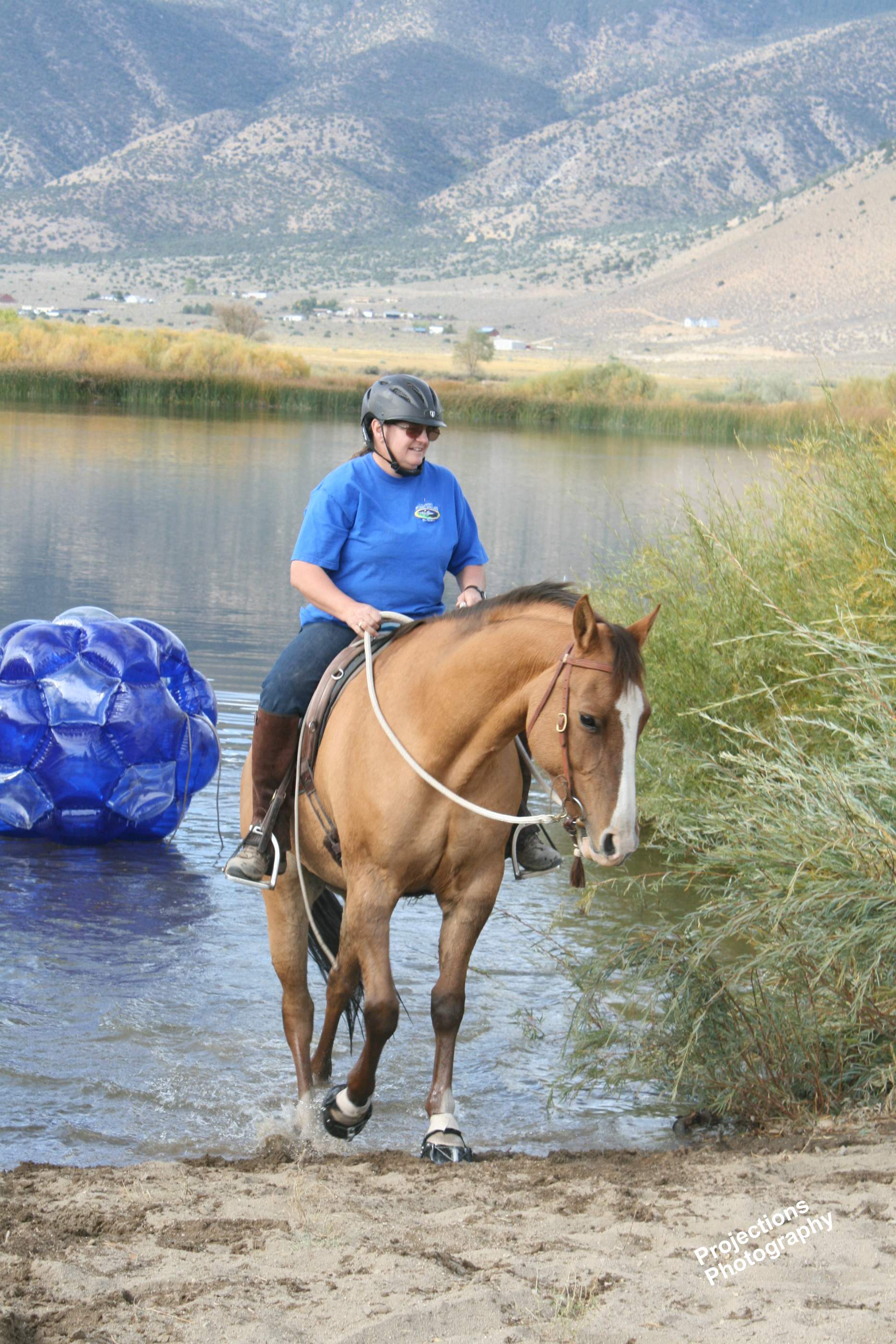
The water obstacle at the Trail Trial photo courtesy of Kitty Carlisle, Projections Photography

I discovered something at the TnT clinic that I did not expect to find. It upset me very much. Dolly was looking for Po. I hadn’t had her out with other horses since he died over a year ago, so I knew she might be a little silly, but I didn’t expect that. The first thing she did was buddy up to the horse in the stall next to her. At first, I thought she was yelling for him, but later realized he was standing right next to us. She kept craning around and staring of into the distance at all the other horses and screaming her head off (right in my ear, which makes it a bit difficult to listen!). Of course, all of the feelings of loss and grief began to surface in me, on top of the fact that I felt terrible for her, on top of the fact that she was screaming in my ear. I decided I needed to get her out more!

So yesterday, we trailered over to Smith Valley to do the annual Alzheimers Ride at the Hunewill Ranch. There is a Trail Trial, followed by the ride itself. I decided to sign up to do both. My goals for the Trail Trial were simple: walk quietly between obstacles on a loose rein, wait quietly for your turn at obstacles on a loose rein, don’t get silly about the other horses. Notice that my goals had nothing to do with the obstacles. I figured I’d just do what I could and not worry about scores. It would be good experience for Dolly and give purpose to what we were doing. We didn’t do so well on some of the early obstacles. She wanted to rush when she needed to stop and relax, so that’s added to the list of goals for the future. But, basically, Dolly tried at every obstacle and did very well in between them. She screamed once or twice, but the only time she got concerned was when a group of 4 horses we had been following disappeared into some willows up ahead and she wanted to catch up.

The ride itself started right after we finished the Trail Trial. There must have been maybe 50-60 horses there. I rode with my friend Sandra and it was a beautiful autumn day for a trail ride through the cow pastures. Except that it wasn’t exactly an “autumn” trail ride. After the first dry pasture we rode through, we hit the wet. And then more wet, and even more wet (it was a wet year!). It was kind of the Mud Bog Alzheimers ride. Fortunately, I had double taped Dolly’s Easyboot gaiters with Elastikon so they stayed on the whole ride. Dolly was just a little champion about going through all the boggy, marshy and creeky stuff. I was very proud of her. Sandra’s horse Tesega was reluctant at first, but by the time we had waded through about a mile or so of boggy stuff, even he was squelching through the bad spots like it was old hat. About halfway through the ride, Sandra noticed there weren’t very many riders behind us anymore—I guess a bunch of them turned back at one of the ditch crossings because it was so wet!

Dolly was quite tired by the end—I had been in the saddle for almost 4 hours. When we got back to the trailer, she got oodles of good cookies and a well-deserved roll (giving new meaning to the word Claybank). Then I left her with hay and water and headed over to the barbecue. If you are a local and haven’t done this ride before, it is well worth it just for that part. There is always lots and lots of great homemade food and good live entertainment. In fact, it is worth it just to show up for the barbecue even if you don’t want to ride—there is a run you can participate in before the rides or just make a $30 donation to Alzheimers research when you get there. There is also a silent auction and a raffle that you can join in on. So we were sitting around eating when they announced the winners of the Trail Trial and Dolly and I came in second in our division! How funny is that? (It has occurred to me that there may have only been two people competing in my division, but I can live with that.) I won a nice leather punch that can live in the horse trailer and Dolly got a few more oodles of cookies. To top it off, I won three of the raffle prizes. In the end, Megan Hunewill announced that we had raised over $10,000 for Alzheimers Research.

Attack of the killer bunnies!

I don’t know what is going on right now, but there seem to be an awful lot of kamikazi bunnies out on the road lately.  Usually, I might see one or two as I drive in to work in the morning.  One morning, as I was driving in early, I came upon three bunnies lined up in the road facing me.  It was one of those moments when I wished I was carrying a camera along with me.  Except that I know that by the time the thought molecules actually hit my brain and my brain activated to send a message down to my hand to “pick up the camera,” either the bunnies would be long gone, or I would have run them down.

So there we were, just me and the bunnies in a bizarre Mexican standoff reminiscent of some cheesy horror flick.  They were probably just having a little bunny confab out there in the middle of the road when I came driving along and they turned to see what the all the noise was.  I prefer the horror movie version, though.  You hear the haunting Ennio Morricone score in the background as the bunnies stare, their lucky little feet hovering over imaginary little holsters, the jingling of tiny spurs in the background.  The camera pans and then it zooms to show only my eyes—wide, afraid, darting back and forth between the bunnies.  Then the camera pans back to show the center bunny.  It zooms in to show just his eyes.  He wiggles his cute little nose and the spell breaks.  The movie ends.  They run away.

Lately, I see half a dozen, even a dozen each morning.  They dash along the side of the road seeking a way to escape me, but perversely choose to stay on the road rather than flee into the sagebrush.  Usually, they “try to escape” by running in front of the car.   It is the running of the bunnies—far safer than bulls at any rate.  This morning I counted 9, although only one of them foolishly tried to get me to run over it.  I really do try to avoid them.  One time late at night on a trip home from Vegas, I hit one coming over Anchorite Pass out of Hawthorne.  I can still hear the sickening crunch it made—ick!  It happened so fast that there was no way I could have avoided it, but still—ick!  I don’t want to repeat that so I drive slow and try to avoid them.

Is it because it is fall?  It doesn’t really make sense because they don’t hibernate.  Is there a shortage of food this late in the year?  But there is certainly no food on the road to attract them.   It’s not mating season… I mean I could see the males showing off for the females…”check this out babe!”  (It would certainly narrow the gene pool to those that are the fastest and/or least foolish.)  But it’s the wrong time of year for that.  Is the road surface warmer?  Maybe running alongside a car warms their little tootsies.   Maybe it’s just National Bunny Deathwish Month.  Silly rabbits!

TnT notes: Am I really in Neutral?

I’d like to start this off by stating that I can’t possibly write down everything that Trevor and Tara taught during the clinic.  In fact, I’m pretty sure I couldn’t even hope to capture everything I was supposed to have learned there.  The best I can do is try to convey my interpretation of what insights I may or may not have gleaned as a result of spending two days playing with concepts in a clinic setting.  It sounds pretty vague, but that’s about the best you can expect, I think, and about the best I can deliver.

In level 3 and 4, we work on refining everything we learned in levels 1 and 2 until it becomes seamless.  We call it unconscious competence.  The operative question is “how little can I do and still get the desired result?”  If we do too little, our horse won’t understand—too much and we are shouting.  And if we do just a little, but we do it  all the time, we are nagging.  We have to learn to give the signal as quietly as possible, then go to neutral and stay there and let the horse be responsible for his actions.

Tara spent part of the first morning having us play with this concept of neutrality.  She began by demonstrating with Amy, a Percheron mare.  She used the game “don’t make me pick up the stick” on a circle.  Only now, in level 3, she was far more particular about what she expected from Amy.  If she sent Amy at a trot, Amy was to go at a trot.  If she asked Amy to slow to a walk, she explained that Amy must do so within one quadrant of the circle.  (Later, you would refine this down to an eighth of the circle, then even less as the horse improves.)  If she asked Amy to canter or make any other transition, she must do it within one quarter of the circle also.

Each time Amy didn’t respond within the allotted time, Tara would pick up the stick and wiggle it (in the case of a down transition) or spank the ground (for an up transition.)  Then she would disengage Amy and bring her in, then send her right back out in the other direction and ask the same thing.  This kind of correction only makes it more work for Amy every time she doesn’t respond and gives her incentive to respond faster next time.    The idea was that if Tara had to “come out of neutral,” Amy would have to disengage and change directions.  She explained that she always sent Amy in the other direction because it was more work—you might not need to change directions with a different horse, but you would always disengage.

So off we went to play with the concept.  It became immediately obvious to me that I come out of neutral a lot!  Only when I come out of neutral, it is far more subtle than what Tara had to do with Amy.  Dolly is so responsive, that coming out of neutral for me can be as simple as picking the tip of the stick off the ground or moving one foot forward and lifting a hand.  (If I really spanked the ground on an up transition, Dolly would be in Utah before I got her disengaged!)  I kept making these little movements and then realizing that I had come out of neutral and should have disengaged Dolly and oops, now it’s too late and, oh dang, I just did it again!  It was very awkward.  But I was becoming aware.  Tara also pointed out that I was picking up the stick to ask for the down transition, not asking first, then picking up the stick when she doesn’t respond.  Hmmm…

To add to the fun, we were in a large pasture/playground area and the grass was wet.  We had to make a smaller circle than usual between the “toys” and Dolly was afraid she might slip on the grass.  (She wasn’t the only one—I had my heart in my teeth a couple of times thinking about vet bills!)  It occurred to me that I was making these small movements to try to “help” her when really I should just shut up and let her figure it out.  In the end, the result would be the same.  By trying to help her gain confidence in going forward, I was only making noise that would begin to desensitize her to my signals.  So at that point, I sort of gave up on that and put it in the points to ponder file.

When I finally had time to play with this idea again, we were at home in our non-slippery footing and on our big circle.  I resolved to pay close attention to the question of what specific actions constitute “coming out of neutral.”  It felt much less awkward.    I found what I already knew to be true.  Dolly consistently gives me up transitions within a stride of asking, but the downs aren’t so good.  We spent a lot of time doing trot to walk.  First, the body language and then wait for my quarter of a circle.  Still trotting?  Wiggle the stick, disengage, bring her in, quick pat, send her back out again at the walk (after all, the walk was what I wanted.)  Ask for the trot.  Try again.  After about the fifth time, I could see the question in her eyes.

“Really? … Because you just disengaged me and brought me in and now you want to do it again?  I didn’t even make a full circle! Is this really necessary?”

Bringing her in became work because she knew she was going right back out.  She started trying to solve the puzzle.  By the tenth or twentieth time, the look became more disgusted.  Finally, she figured it out and began to do the down transitions off of my body language.  At that point, I brought her in for a good long soak.

We played with this again the next day.  I still have work to do on the down transitions.  All this time of being noisy first, then asking for the transition later has taught her to ignore my body language.  However, it didn’t take nearly as long for her to figure it out the second time.   I’ll let you know when we get around to doing canter-halts!

And all this was just the second half of Saturday morning.  You can see why clinic notes are a slow process for me.


My inspiration

Eldorado

Gaily bedight,
A gallant knight,
In sunshine and in shadow,
Had journeyed long,
Singing a song,
In search of Eldorado.

But he grew old-
This knight so bold-
And o’er his heart a shadow
Fell as he found
No spot of ground
That looked like Eldorado.

And, as his strength
Failed him at length,
He met a pilgrim shadow-
“Shadow,” said he,
“Where can it be-
This land of Eldorado?”

“Over the Mountains
Of the Moon,
Down the Valley of the Shadow,
Ride, boldly ride,”
The shade replied-
“If you seek for Eldorado!”

Edgar Allan Poe

Finally!

Got tired of posting notes to Facebook, so I finally got a real blog with my really own domain name.  Very cool.  Now I need to figure out how to post these to Facebook and we will be all set!  Of course, I’m doing this in the middle of a very busy week at school, so this will probably languish for a few weeks until I can figure out how to do more with it.  In the meantime–hope to see you real soon.